
Introduction: When Speculation Becomes Reality
For centuries, human beings have gazed up at the stars, turned inward toward the microscopic, and wondered what tomorrow might bring. While many look to science and data to forecast human trajectory, storytellers have often beaten the scientists to the punch. The best science fiction books that predicted the future do not merely guess what will happen; they tap into deep anxieties, technological potentials, and human behaviors, extrapolating them into vivid, terrifying, or wondrous realities.
When we read classic speculative fiction today, we often experience a strange sense of déjà vu. We swipe on flat glass rectangles that function as global encyclopedias, live under the watchful eye of algorithmic surveillance, and grapple with ecological collapse—all scenarios mapped out decades, sometimes centuries, before they materialized. In this comprehensive guide, we will explore the masterworks of speculative fiction that accurately anticipated our modern world, examining how these authors pierced the veil of time and what their visions teach us about our own trajectory.
1. Brave New World by Aldous Huxley: The Prison of Pleasure
 Brave New WorldAbout the book →
Published in 1932, Aldous Huxley’s Brave New World is frequently contrasted with George Orwell’s 1984. While Orwell envisioned a future controlled by brute force, pain, and overt tyranny, Huxley foresaw a society enslaved by its own appetite for pleasure, distraction, and comfort. His prophetic insights into pharmacology, mass consumerism, and genetic engineering remain staggering.
Huxley predicted a world where natural human reproduction was replaced by batch-processing in hatcheries, engineered for specific social castes—a chilling precursor to modern debates surrounding genetic manipulation and CRISPR technology. Furthermore, his fictional drug, "Soma," acts as an uncanny mirror to our modern reliance on pharmaceuticals, social media scrolling, and escapist entertainment to numb everyday existential dread.
Key technological and societal predictions in Brave New World include:
- Pharmaceutical Coping Mechanisms: The widespread use of legal, state-sanctioned mood-altering substances to maintain social stability and personal happiness.
- The Erasure of History: A culture hyper-focused on novelty, where the past is viewed as irrelevant and books of historical or philosophical depth are actively suppressed or discarded.
- Conditioning and Consumerism: Constant subconscious messaging used to program human desires, ensuring a continuous loop of buying, discarding, and consuming.
"Actual happiness always looks pretty squalid in comparison with the overcompensations for misery. And, of course, stability isn't nearly so spectacular as instability. And being contented has none of the glamour of a good fight against misfortune, none of the picturesqueness of a fatal struggle with temptation, or a fatal defeat by passion or doubt." — Aldous Huxley, Brave New World
2. Neuromancer by William Gibson: Coining Cyberspace
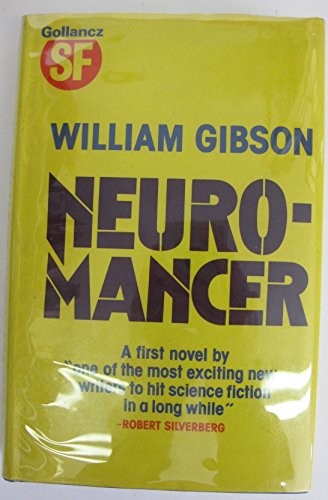 NeuromancerAbout the book →
Long before the World Wide Web became a household fixture, William Gibson’s 1984 debut novel, Neuromancer, gave us the vocabulary for the digital age. Gibson coined the term "cyberspace" and envisioned a global data network navigated through direct neural interfaces—a concept that grows closer to reality every day with companies developing brain-computer interfaces.
What makes Neuromancer one of the best science fiction books that predicted the future is its sociological accuracy. Gibson did not see the future as a utopian playground of pure science. Instead, he foresaw a gritty, corporate-dominated landscape where nation-states are weakened, massive multinational conglomerates rule supreme, and underground hackers manipulate data in the shadows. He anticipated the rise of artificial intelligence, globalized digital black markets, and the blurring lines between human biology and machine enhancements.
Consider the core elements of Gibson’s vision that have manifested in our world:
- The Internet as Consensual Hallucination: A worldwide matrix of shared information that users "jack into," mirroring our modern immersion in virtual reality and online spaces.
- Corporate Hegemony: Governments taking a backseat to monolithic tech corporations that hold monopolies over essential infrastructure and data.
- Cybernetic Modification: The widespread adoption of prosthetic enhancements, data-storage implants, and modular physical upgrades.
3. Fahrenheit 451 by Ray Bradbury: Screens, Earbuds, and Fact-Free Societies
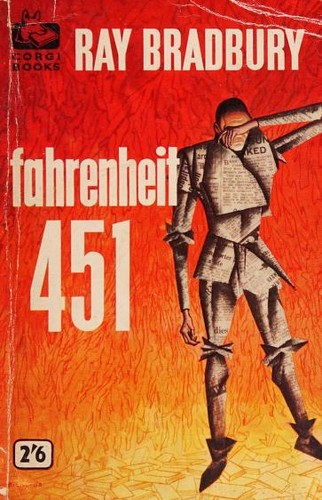 Fahrenheit 451About the book →
Ray Bradbury’s 1951 masterpiece, Fahrenheit 451, is ostensibly about a world where books are outlawed and firemen burn any that are discovered. However, beneath the dramatic premise lies a series of startlingly accurate prophecies about how modern media would reshape human attention spans, interpersonal relationships, and political discourse.
Bradbury envisioned a society addicted to wall-sized interactive television screens—which he called "parlor walls"—that broadcast shallow, hyper-stimulating entertainment designed to keep citizens pacified. He also predicted tiny, seashell-like radios worn constantly in the ears, feeding music and chatter directly into people's brains all day and night. Sound familiar? These are our modern smartphones, flat-screen televisions, and wireless earbuds.
Furthermore, Bradbury warned against the death of nuance. In his world, books weren’t just banned by oppressive governments; they were abandoned by a public that preferred fast-paced, easily digestible sound bites, political correctness enforced by outrage mobs, and simplified narratives over deep critical thinking.
4. The Shockwave Rider by John Brunner: Computer Worms and Mass Surveillance
 The Shockwave RiderAbout the book →
While authors like Arthur C. Clarke and Isaac Asimov imagined grand cosmic futures, John Brunner’s 1975 novel The Shockwave Rider zoomed in on the terrifying implications of the information age. Brunner anticipated the internet, computer hacking, data privacy violations, and algorithmic tracking with a precision that borders on clairvoyance.
Brunner coined the term "worm" to describe a self-replicating computer program designed to spread across a network—years before the first real-world internet worm was ever deployed. He also foresaw a world of "dataveillance," where every financial transaction, travel record, and personal preference is tracked, compiled, and weaponized by institutions and bad actors.
Actionable lessons from Brunner’s prophetic work include:
- Digital Footprints: Recognizing that every digital action leaves a permanent trail that can be aggregated to profile human behavior.
- Information Overload: Anticipating how the constant influx of real-time global news would degrade mental health and fracture collective attention.
- Algorithmic Echo Chambers: The tendency of automated systems to feed users information that reinforces their pre-existing biases, polarizing society.
Conclusion: Why Reading Speculative Fiction Matters Today
The best science fiction books that predicted the future do not possess magical powers of foresight. Instead, their authors possessed a profound understanding of human nature, combined with the intellectual curiosity to follow technological and societal trends to their logical conclusions. They serve as warning systems, flashing neon signs on the highway of human progress, urging us to look up and consider where we are steering our civilization.
As we navigate an era defined by artificial intelligence, genetic engineering, climate change, and hyper-connectivity, returning to classic and contemporary speculative fiction is more than just a pastime—it is a survival manual. By studying the futures these authors imagined, we equip ourselves to build a better, more conscious present. The next time you open a sci-fi novel, remember: you might just be reading tomorrow's history book.





